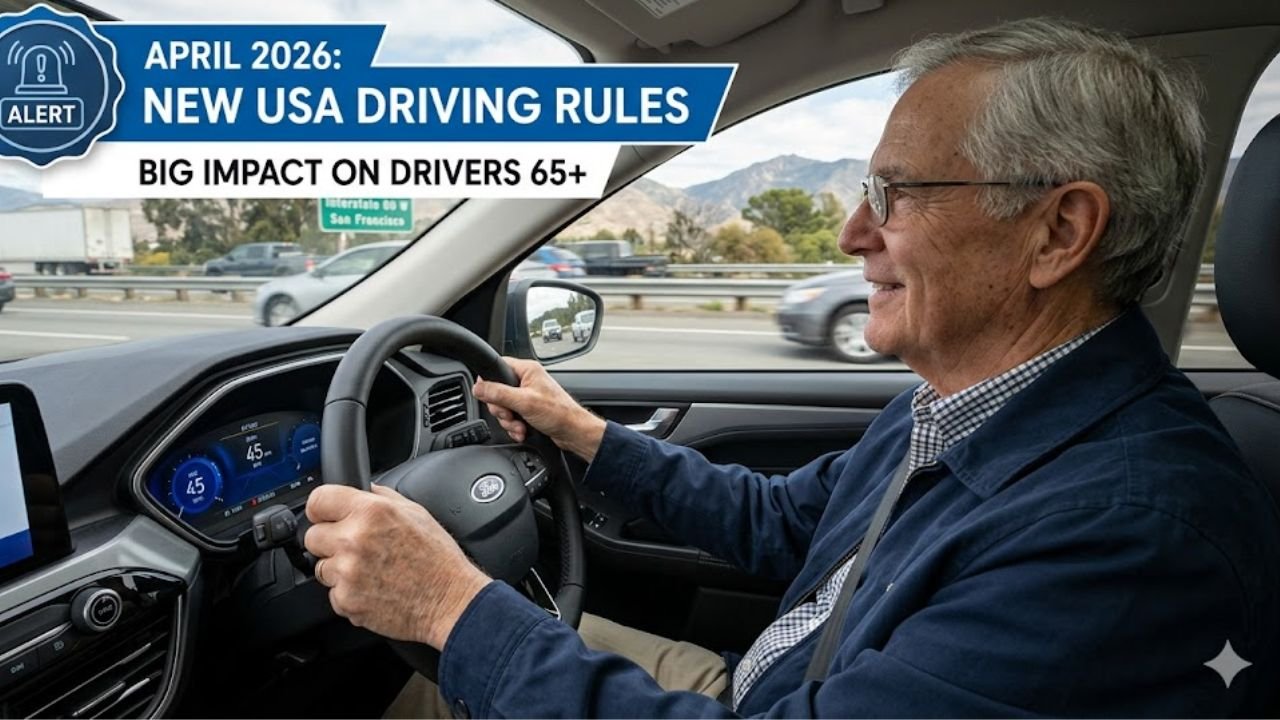
As of April 2026, a significant transformation in road safety regulations has officially taken root across the United States, specifically targeting the demographic of drivers aged 65 and older. While the freedom of the open road has long been a hallmark of American senior life, the National Highway Traffic Safety Administration (NHTSA) and various state Departments of Motor Vehicles (DMV) have introduced a more rigorous federal framework to address the evolving complexities of modern traffic. These changes are not merely administrative updates; they represent a fundamental shift toward proactive safety screening. For many seniors, this means that the familiar process of a simple license renewal has been replaced by more frequent vision assessments, cognitive screenings, and, in some jurisdictions, mandatory in-person evaluations. These measures aim to balance the independence of seasoned drivers with the increasing density of high-speed urban environments and the integration of semi-autonomous vehicle technologies.
Enhanced Medical and Vision Screening Standards
The most immediate impact felt by the 65+ community involves the heightened requirements for medical fitness. Starting this month, several states have implemented a policy where vision tests are no longer a “one and done” event during a decade-long renewal cycle. Instead, drivers over a certain age threshold—often starting at 70 but with preliminary checks at 65—must provide updated vision certifications from a licensed optometrist every two to four years. Furthermore, the “April 1st Federal Safety Framework” has encouraged states to adopt cognitive baseline tests. These are not meant to be “pass or fail” barriers that instantly revoke a license, but rather diagnostic tools to identify early signs of slowed reaction times or spatial awareness issues. By catching these changes early, the DMV can offer restricted licenses—such as “daylight-only” or “radius-limited” driving—which allow seniors to maintain their daily routines while significantly reducing the statistical risk of nighttime or highway accidents.
Stricter Penalties and New Traffic Enforcement Technology
In tandem with renewal changes, the enforcement of road rules has become more automated and less forgiving. The widespread rollout of AI-powered speed cameras and distracted driving monitors in 2026 has caught many experienced drivers off guard. These systems are specifically designed to detect hands-on-phone violations and “slow-roll” stops at intersections. For seniors, the financial stakes are higher than ever, with some states increasing fines for distracted driving to over $500 for repeat offenses. Additionally, the expanded “Move Over” laws now require drivers to vacate the lane closest to any stationary vehicle with hazard lights on—not just emergency responders. Understanding these nuances is critical for older drivers who may have learned the rules of the road in a different era. The goal of these strict enforcements is to create a predictable environment where automated systems and human drivers can coexist safely.
Comparison of Key Senior Driving Requirements by State (2026)
| Requirement | California | Florida | Illinois | Michigan |
| Renewal Cycle (65+) | Every 5 Years | Every 6 Years | Every 2-4 Years | Every 4 Years |
| Vision Test | Required at Renewal | Required at Renewal | Required at Renewal | Proactive Every 4 Years |
| Cognitive Screening | Case-by-Case | Mandatory for 80+ | Required for 79+ | Proposed for 75+ |
| In-Person Renewal | Mandatory for 70+ | Mandatory for 80+ | Mandatory for 75+ | Mandatory for 65+ |
Adapting to Digital Driver’s Licenses and Vehicle Tech
Technological literacy is becoming a prerequisite for maintaining driving privileges in 2026. Many states have moved toward Digital Driver’s Licenses (mDLs), which can be stored on a smartphone. While physical cards are still available, the mDL allows for real-time updates regarding medical certifications or driving restrictions. Moreover, modern vehicles are now equipped with Advanced Driver Assistance Systems (ADAS) that are becoming a focus of DMV road tests. Seniors may find that their local DMV now requires a brief demonstration of their ability to use lane-keep assist or emergency braking features. For those who drive older models, there is a growing push for “Tech-Retraining” seminars, which help seniors understand how to navigate roads that are increasingly populated by fully autonomous delivery vehicles and “smart” intersections that communicate directly with newer cars.
Maintaining Independence Through Proactive Compliance
Despite the initial stress these new rules might cause, the ultimate objective is to preserve senior mobility, not eliminate it. Experts suggest a “7-Step Legal Shield” approach to stay ahead of these changes: checking license status online monthly, maintaining a fresh vision report in the glovebox, and investing in hands-free Bluetooth mounts. Many insurance providers in 2026 are also offering “Senior Safety Discounts” for those who voluntarily complete certified defensive driving courses or install telematics devices that prove safe driving habits. By being proactive rather than reactive, drivers over 65 can demonstrate their continued competence and avoid the “surprise” of a failed renewal or a heavy fine. The road is changing, but with the right preparation, the 65+ community can continue to navigate it with the same confidence and skill they have exhibited for decades.
FAQs
Q1 Do these new 2026 rules mean I will lose my license automatically at age 75?
No. The rules are designed to assess individual fitness rather than impose a hard age limit. As long as you pass the updated vision and cognitive screenings, you can continue to drive.
Q2 Are the AI speed cameras really legal in all states?
As of April 2026, over 35 states have passed legislation (such as California’s AB 645) allowing the use of automated speed cameras in high-risk zones, with fines mailed directly to the registered owner.
Q3 What is a “Restricted License” for seniors?
It is a compromise that allows you to keep driving under specific conditions, such as only during daylight hours or within a 20-mile radius of your home, ensuring you stay mobile while minimizing risk.