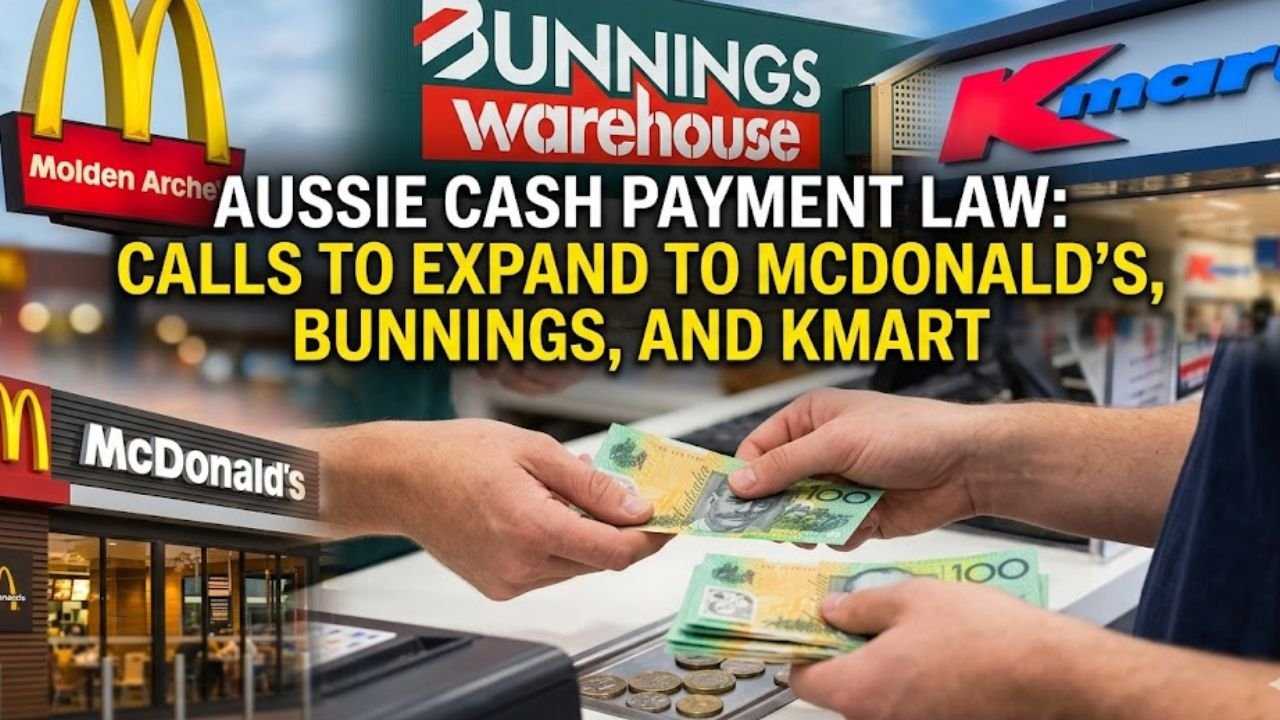
Since January 1, 2023, Australian businesses have been allowed to set their own cash acceptance policies, however, for businesses deemed ‘essential’ by the Australian government, cash acceptance has been mandated. Retailers have been pushing Australia’s ‘tap-and-go’ payment system as the primary way to pay, however, some of Australia’s population has been excluded from this payment system, thereby leaving Australia’s government with little choice but to create this cash acceptance policy. At this point in time, the focus on this policy is on Australia’s supermarkets and fuel stations with a yearly turnover of over $10 million dollars. As the policy is in its early days, more and more people, especially those in regional and rural areas, are calling for the cash acceptance policy to be expanded to include McDonald’s, Bunnings, and Kmart. This is especially true for those businesses that can be considered cornerstones of Australian culture. Excluding them from the cash acceptance policy creates a disjointed economy and punishes the most vulnerable in Australian society.
The Need for More Options to Access Money in Grocery Stores
Most of the current legislation is focused on survival, things like food and transport. But for many in Australia, what is “essential” is much broader than just bread and petrol. Take Bunnings for example, this is countless thousands of tradespeople and the DIY Bunnings, it is the main store for tools and urgent home repair supplies. The Same goes for Kmart, this store is one of the most important for providing affordable clothes, bedding, and school supplies to families with little income. All the stores mentioned above, and many others in this category, are moving to fully cashless self-checkouts. If someone relies on cash to manage their money, or they simply do not have a bank account, they are left without any way to shop at the store. The same goes for inclusion of McDonald’s, as the biggest fast food chain, it is a main source of food for shift workers, students, and the homeless. Putting the “lifestyle essentials” fully digital is in the eyes of many the beginning of a two-tiered society where the majority can have conveniences at the expense of the dignity and access of the minority.
2026 Cash Acceptance Framework Overview
To fully understand the arguments surrounding Kmart/Bunnings potential expansion, we need to unpack the existing legislation. The 2026 regulations are designed more as a ‘safety net’ rather than a defacto reversal of the trends we are witnessing with digitisation. It attempts to strike a balance between the need to ensure some resilience in the face of outages, as we have seen with Optus and major banks in the past, and the ‘flexibility’ that is required to run a business in the current environment. Below is a summary of the current regulations that advocates want to see applied to the more broad, general retail landscape:
| Feature | Current 2026 Regulation Details |
| Primary Sectors | Grocery stores, Supermarkets, and Fuel Stations. |
| Transaction Limit | Cash must be accepted for in-person payments up to $500. |
| Mandatory Hours | Acceptance is required between 7:00 AM and 9:00 PM. |
| Exemptions | Businesses with less than $10 million annual turnover. |
| Review Period | A formal statutory review is scheduled for 2029. |
| Compliance Fines | Repeat offenders face penalties up to $55,000. |
Operational Challenges versus Consumer Rights
Retail behemoths such as Wesfarmers, the parent company of Kmart and Bunnings, have traditionally pointed to cash-handling costs as one of the key motivators for adopting a digital-first business model. The major costs of dealing with cash are secure transport, insurance, manual cash counting, and theft mitigation.
From a corporate point of view, a cashless society is not meant to eliminate cash acceptance for the elderly, but rather to increase profits. However, the public policy E-E-A-T standards tell us that the gross social contract between a large retailer and the community is of a social benefit beyond profit. Retailers such as Kmart and Bunnings effectively become large public squares. Financial inclusion experts counter that cash acceptance is a burden to society, yet it is a social cost that must be born in a community of approximately 10% cash reliant individuals. If the State imputes a legal obligation to a small scale retailer such as Coles to accept a $20 note for a bottle of milk, then, logically, the same obligation must extend to Kmart when the item for sale is a pair of school shoes.
Resilience and the “Plan B” Economy
Apart from the social justice reasoning, a case that can be made for expanding the mandate to McDonald’s and Bunnings is a case for national resilience. Australia is becoming increasingly reliant on a single, digital point of failure that can be undermined by cyber attacks, solar flares, and ordinary infrastructure failures. During the 2024-2025 period, a number of high-profile outages meant that many people were unable to purchase even the most essential items because they did not have a backup. Australia is fundamentally constructing a decentralized backup system for its economy by mandating large-scale cash-out infrastructure to large non-grocery retailers. If the lights go out or the bank’s servers are down, a customer should be able to go to a supermarket for food or to McDonald’s or Bunnings to buy a hot meal or a generator, for cash that is backed by the Reserve Bank of Australia. This “Plan B” approach is what the proposed law is aiming for as we look to 2026, with many anticipating a focused conversation on expanding the mandate before the new year.
The Future of Payments in Australia
The issue of cash isn’t whether we should modernize, but how we can modernize while making sure we don’t leave anyone behind. Tap-and-go technology may be very convenient for the average user, but the law requiring cash to be accepted provides some stability to the economy. The Federal Government has to decide if efficiency is more important than providing universal access, while the demands for the 2026 mandate to include McDonald’s, Kmart, and Bunnings grow. With the current successful implementation of the mandate for grocery and fuel, the government has set the benchmark. If there is no major disruption or price increase for these industries, the justification for ‘cards only’ signs is virtually removed for all other major retailers. It is only a matter of time before we see more lobbying on both sides of the argument. For the millions of Australians who still prefer cash for transactions, the message is clear. Cash is only going to become more legally protected and more ubiquitous.
FAQ
Q1 Does the new law mean every shop in Australia must take cash?
No. The mandate only applies to fuel stations and grocery stores with an annual turnover of more than $10 million. Other retail sectors may remain cashless and small businesses can choose to go cashless if they decide.
Q2 Why have some people suggested the inclusion of Kmart and Bunnings?
Supporters contend that Kmart, Bunnings, and similar stores sell items that are just as important as food, such as home utility items and clothes, and therefore, large retailers should build some level of social responsibility. This applies to people, especially elderly people, who do not have access to online banking. It is suggested that large retailers should not restrict their social responsibility to food items.
Q3 Will there be a restriction on the amount of cash I can use with the new payment rule?
Yes. For the businesses that the new payment rule applies to, they are only permitted to accept cash for in-person transactions of up to $500. For anything cash related and those purchases that are done after 9:00 PM, they can continue to insist on a cashless transaction.