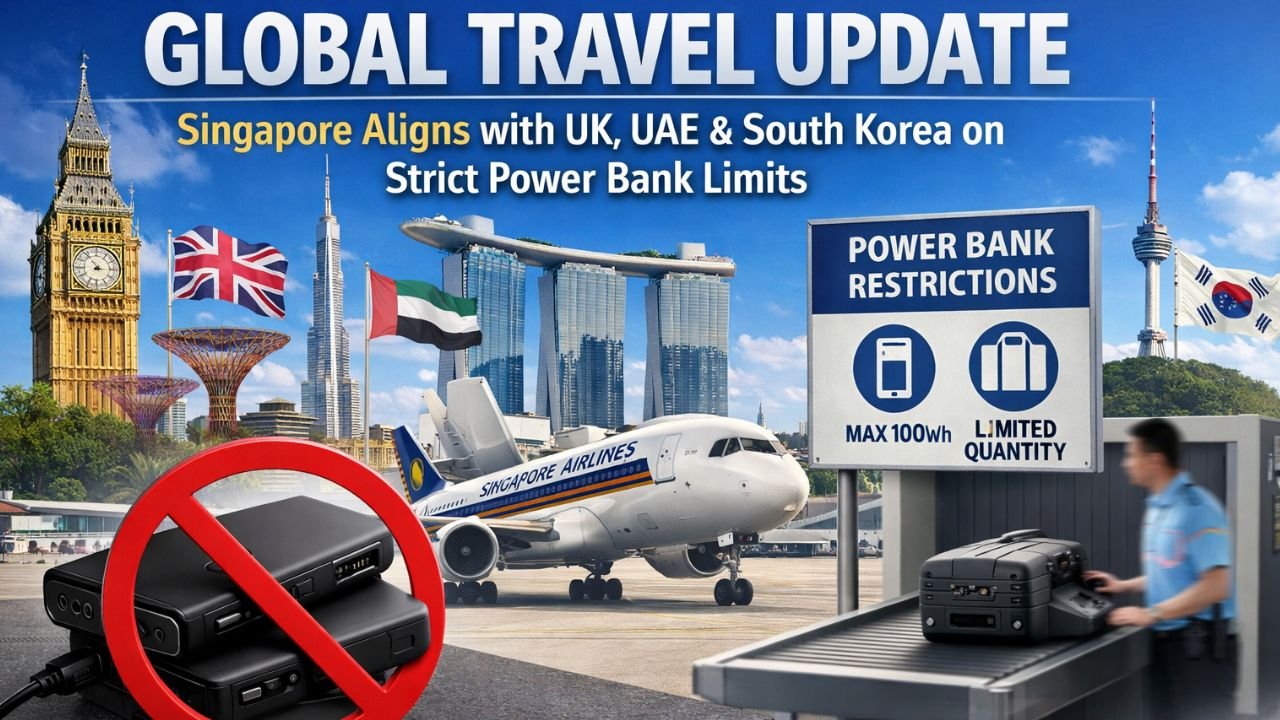
The International Civil Aviation Organization (ICAO) and the International Air Transport Association (IATA) are starting to uniformly implement safety regulations to prevent excessive lithium-ions batteries over the next few years toward the beginning of 2026. Major travel hubs include the United Kingdom, The United Arab Emirates, South Korea and Singapore. Singapore’s Civil Aviation Authority (CAAS) is the first to implement these regulations. These regulations attempt to mitigate the risks associated with thermal runaway. Thermal runaway is when one cell of the battery begins to overheat and self trigger a fire. CAAS will impose restrictions on the amount of portable power banks a passenger is allowed to bring on an airplane. CAAS will also implement some behavioral restrictions during the flight. These new regulations are a significant change for travelers. They are used to more lenient regulations that would allow 10-20 spare batteries. Travelers rely on their portable electronics for a majority of their day to day tasks.
What are New Capacity and Quantity Restrictions in 2026 Guidelines
The 2026 guidelines focus on the number of devices a passenger can take on board and the measured energy capability in watt-hours (Wh). Most travelers are now limited to bringing 2 power banks in their carry-on bags. Also, with regard to powerbank capacity, devices with lower than 100Wh (around 2700mAh) are allowed without any notification, while devices with higher than 101Wh and lower than 160Wh require airline notification/approval that is requested minimum 48 hours prior to that. Therefore, travelers must check that the capacity rating is legibly printed on the device. Currently, the authorities at the major congested airports, such as Changi, Heathrow, and Incheon, are allowed to keep any powerbank with the rating removed, branding, and other such unidentifiable worn ones. The “two-unit rule” is intended to restrict the total lithium content in the passenger cabin and ensure that the cabin crew can deal with the risk of fire during a possible emergency.
What are Power Bank Specifications
To prepare for the upcoming changes, the following table shows the current standard guidelines set by CAAS, IATA and other regional authorities.
| Battery Capacity (Wh) | Equivalent (mAh at 3.7V) | Quantity Limit | Approval Required |
|---|---|---|---|
| Under 100 Wh | Up to ~27,000 mAh | 2 Units Total | No |
| 100 Wh to 160 Wh | ~27,000 to 43,000 mAh | 2 Units Total | Yes (Airline Consent) |
| Over 160 Wh | Over 43,000 mAh | Prohibited | N/A |
| Unlabeled Units | Unknown | Prohibited | N/A |
New In-Flight Restrictions: Charging Not Allowed
Probably the most serious change for long-haul flights is the ban on using power banks, raising the level of difficulty on long flights. During the course of a flight, a power bank cannot be charged. To minimize fire hazards, planes power banks must be stored either under the seat or in the seatback pocket. Power banks in overhead bins creates a fire hazard. Countries like S. Korea & the UAE have banned power banks for this reason. Some airlines even require passengers to cover power banks with tape.
Why Are Things Changing So Fast?
New rules are a response to a real, documented increase in battery-related incidents on commercial flights over the last several years. Batteries are dangerous because of the amount of energy they contain. Even a minor manufacturing defect or some physical damage to the battery can turn it into a very serious fire hazard. To address this issue, the airline industry regulators and the major airports have made harmonized rules to avoid confusion. This means a lithium battery pack and cords that passed inspection in Singapore will still be acceptable on lay over flights in the United Kingdom or South Korea, as long as the passenger complies with the strict limit of 2) units. This will also improve consistency in the ground handling and security training, and will ensure that the millions of passengers are safe in the sky because of the increased risk added by these batteries.
Preparing Your Tech for Future Travels
Travelers should take a closer look at their gadgets and start reorganizing their belongings. People with tech pouches and small battery packs will have to adjust their power sources to one or two devices and make sure the devices are labeled. Additionally, since these gadgets cannot be used during the flight, travelers will have to ensure their devices are charged and ready to go before boarding. Lastly, with the rise of stricter guidelines when traveling, travelers should check their airline’s website to prevent having their items taken by the airline at the security gate.
FAQs
Q1 Can I still put a power bank in my checked luggage?
No. Power banks must always be stored in carry-on luggage because they have been deemed a fire hazard when stored in checked luggage.
Q2 How do I calculate the watt-hours (Wh) of my power bank?
Wh = (mAh x V) \ 1000. For example, 10,000mAh batteries have a V of 3.7. Then, Wh = 10,000 x 3.7 \ 1000 = 37Wh.
Q3 What happens if I have more than two power banks at security?
At airports that have implemented the new 2026 standards, you will be required to get rid of the excess units, or leave them with a travel companion who will be traveling, as they will not be allowed to go past the security checkpoint.